
I built a tool for managing shift occupancy.
One of the most challenging operational types I have dealt with in terms of occupancy is sites with multiple, overlapping shifts. There is a misconception that shift working often means less hybrid and remote working. I have found, in most instances, this assertion to be wrong. Shift workers often have an easier time working remotely, and their managers are more capable of tracking their performance because their tasks are more structured and consistent.
I have worked with sites with shifts across the US, Latin America, South America, India, the Philippines, Asia, and Europe. There was one consistent conversation across all of these sites:
How much space is really needed if I hire X more employees on Y shift?
The challenge is that every shift within a site may operate differently from the others, just as two sites will operate differently. This exacerbates the challenge where managers with different requirements for their teams have with occupancy. When those shifts overlap each other, it creates increased inefficiencies with occupancy when the overlaps are not planned and predictable.
Below is a not-unusual example of how 4 overlapping shifts can impact expected site occupancy. These shifts all have different employee counts, different occupancy averages, and different start/end times. During most windows, there is enough capacity to support additional growth, other than the 8 and 9 pm windows, where we have one shift ending and another beginning, which creates unusual pressure.
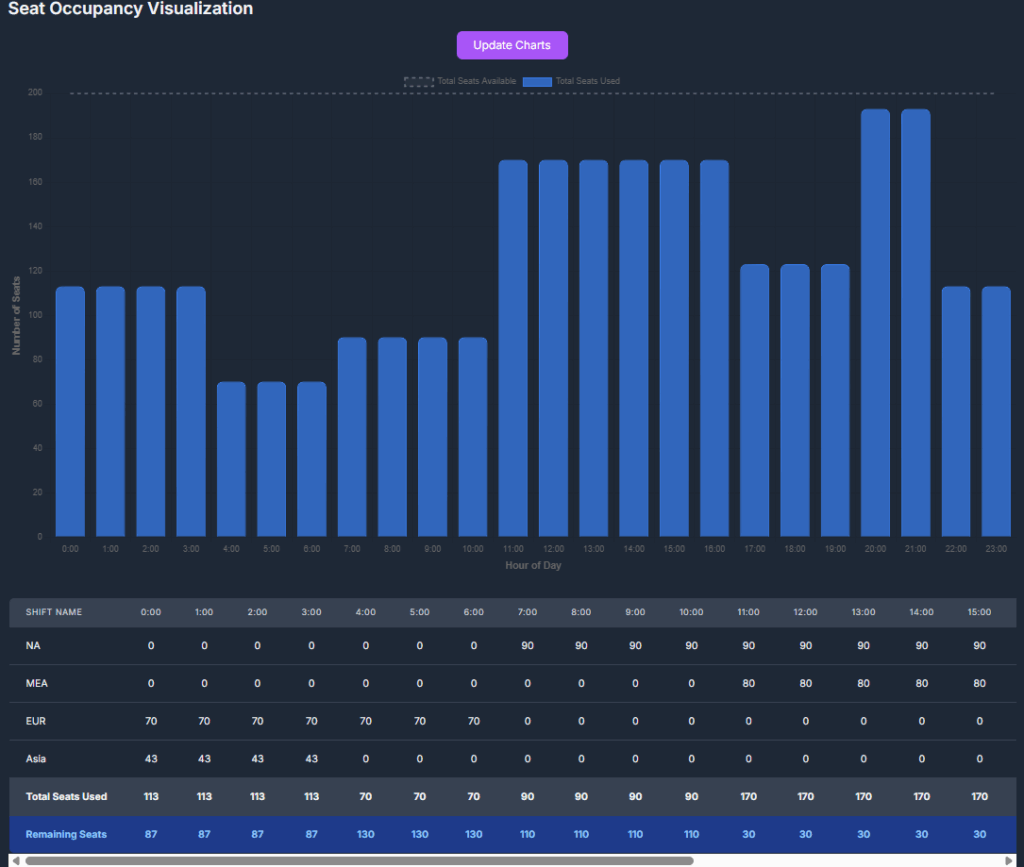
Another difficulty with shift working is that seats do not necessarily free up right when a shift is scheduled to end. There is often a transition period before and after the shift when employees are arriving a bit early to take up their workstation, while others are wrapping up final activities after the clock has ticked over. Similarly, it is not always possible to simply move a shift forward or backward by an hour to accommodate these occupancy impacts because the time was likely set based on when the work was required (maybe overlapping with a supported time zone or client).
Figuring out occupancy for this site (and therefore space requirements) is fundamentally about understanding the interplay between the shifts. Even having sensors in a site like this will only tell you about the number of employees in the space in the moment, it does not tell you about the shift dynamics that led to that occupancy level. Those dynamics can be modeled (with just the basics) using the input form below.
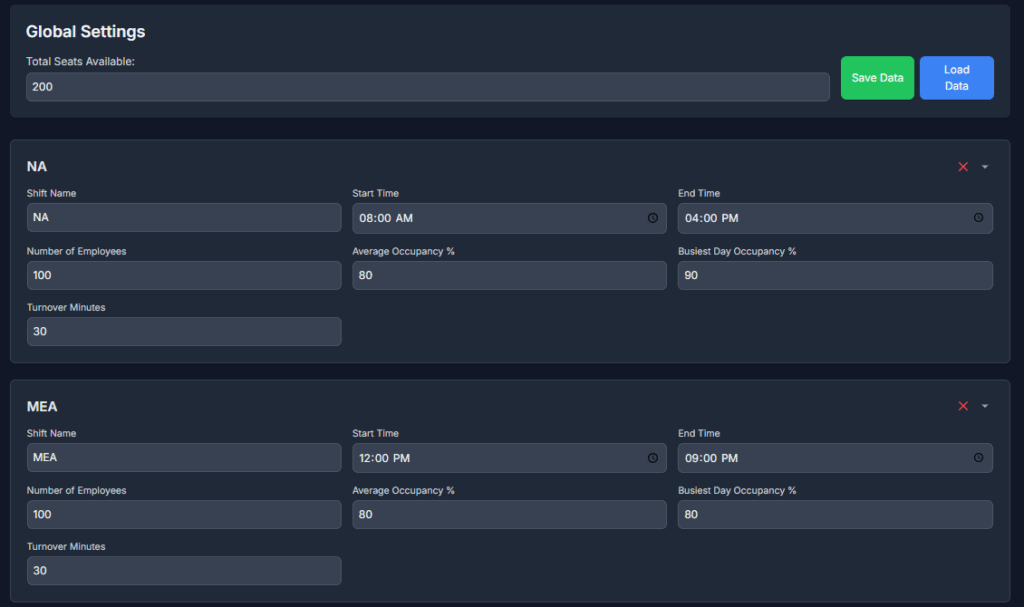
Each shift will be unique. Some may even exist with the same start and end times but have different employee and occupancy numbers. Others may start at the same time but end slightly earlier or later. Being able to set up and manage each of these provides a view of expected occupancy that can then be overlaid against actual occupancy (via badges, bookings, or sensors) to see if the site is operating as expected. From there, the data can be analyzed to update each shifts occupancy levels to align with how things actually played out.
The trick is then being able to test what happens to occupancy if changes are made to the site:
- What if this shift grows by 50%?
- What if a new shift is added from 10 am to 6 pm?
- What if more employees are told to work from the office on this shift?
- How much occupancy is created to allow for more growth if I slightly increase hybrid working rates?
Quickly seeing the expected occupancy impact will then allow you to understand if the site can support those changes or if adjustments are necessary.
If this is something that may be interesting or useful to you, reach out and let’s have a conversation.
Leave a Reply